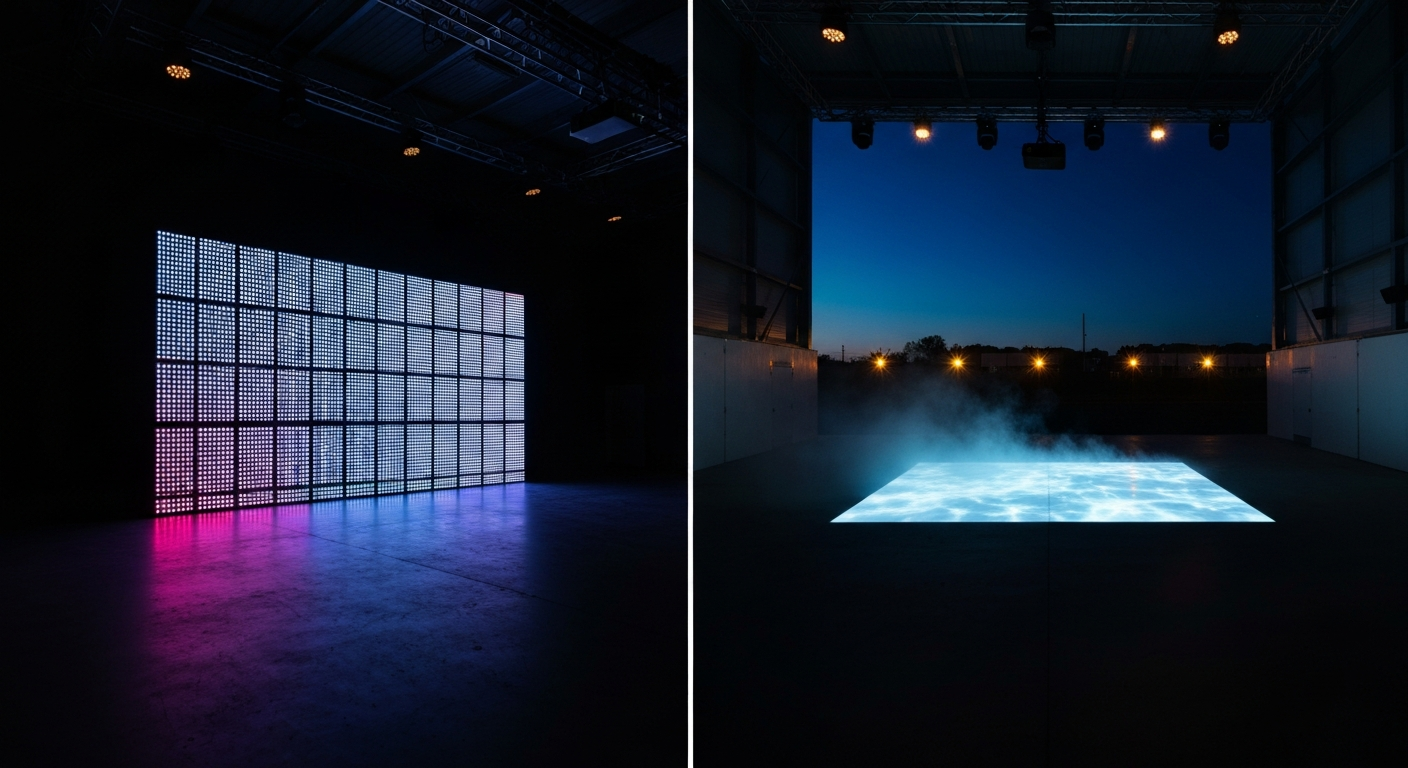
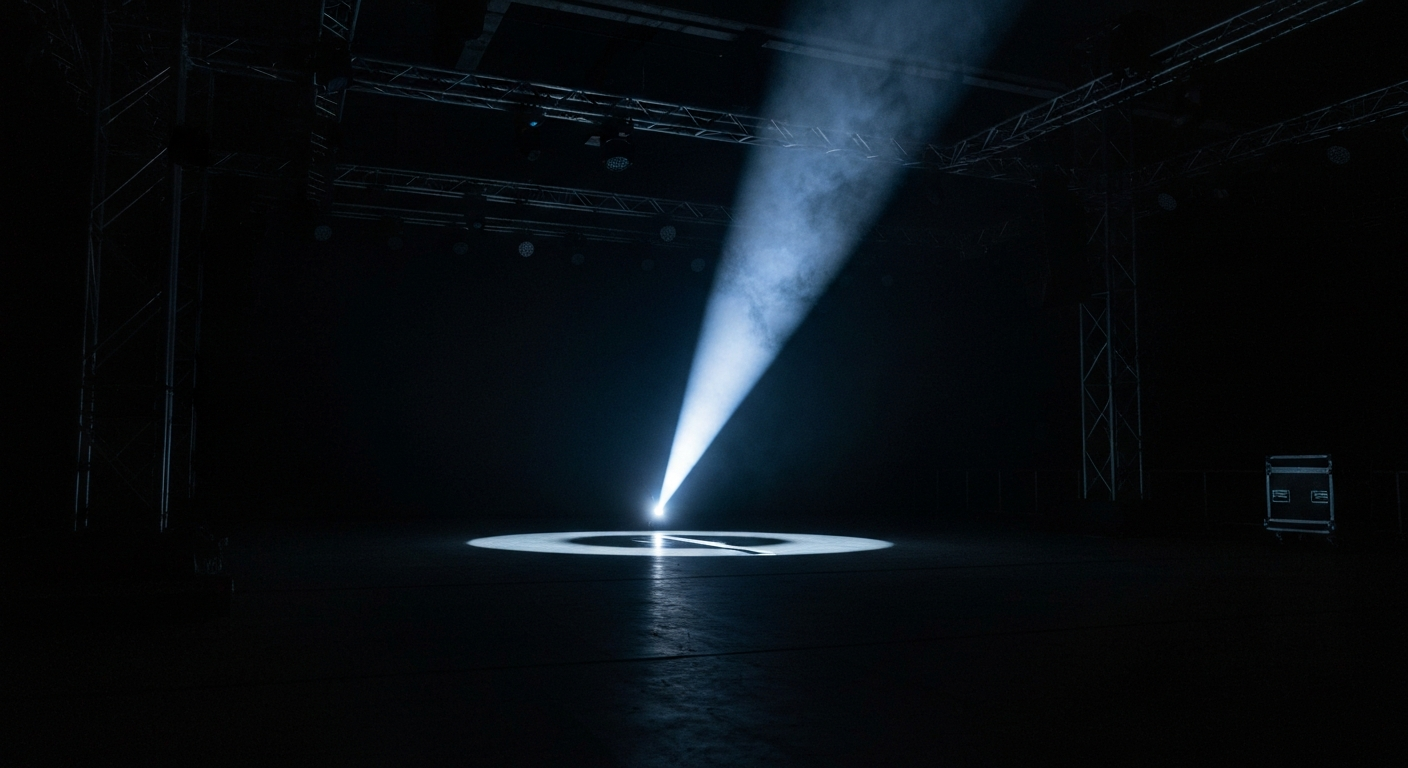
Every event producer has had this conversation. The venue has uncovered windows, overhead ambient lights, a string of patio torches, and a brief asking for a projection-mapped feature wall. "Can we just get a brighter projector?" No. Here's why.
Projection is subtractive
A projector doesn't paint light onto a surface the way an LED does. It shines light onto a surface, and the surface reflects a fraction of that light back at the viewer. If the room is already full of light, the ambient light fills in the dark parts of the projected image - the shadows, the blacks, the negative space that makes the projected imagery readable.
You can add brightness to the projection. But you can't subtract brightness from the room. The result is an image with white-on-white highlights and no blacks - technically visible, aesthetically dead. The show looks washed. No amount of lumens fixes this.
The 10-to-1 rule
A working rule of thumb: for a projected image to read as punchy and high-contrast, the projected highlights need to be roughly 10 times brighter than the ambient light on the surface. For reference, an overhead fluorescent lobby fixture drops about 300 to 500 lux on a wall directly below it. Getting a projected image to 3000 to 5000 lux of highlight on that same wall requires a projector with serious lumen output pointed at a relatively small coverage area.
The instant the coverage area grows, the brightness per square meter drops, and the ratio collapses. A 20K-lumen projector that looks brilliant on a 4x3 meter surface looks grey on a 20x15 meter wall. This is a geometry problem dressed up as a lumen problem.
What venue design can actually do
- Get the windows covered. Blackout drapery is the cheapest major brightness gain any show will ever see.
- Kill the uplights on the surface. Not the room - just the surface. A mapped column with no up-light at its base is suddenly three times more contrasty.
- Use warmer, lower ambient. A room at 50 lux of warm-white ambient feels atmospheric and lets the projection do the heavy lifting.
- Paint the projection surface matte, not glossy. Glossy kicks light specularly and destroys the image at angle.
When the venue can't be dark
Sometimes you don't get a dark room. The brief requires projection during a daytime brunch, or the venue has windows that can't be covered. In those cases, stop fighting it. Switch to LED for the surface that has to cut through ambient, or redesign the projection to live on content that doesn't rely on deep blacks - high-key, saturated imagery that works against a bright background.
Lumens are a lever. Room darkness is a foundation. Every dollar spent on projector brightness in a lit room buys less show than the same dollar spent on blackouts and dimmer controls.
Venue design isn't the sexy part of production, but it's the part that decides whether the show reads or doesn't. Get the venue right and the projection will handle itself.