Every production meeting that touches a large visual surface eventually hits the same question. LED or projection. The conversation usually devolves into a brochure fight - brightness numbers, pixel pitches, rental cost spreadsheets - which misses that the answer almost always comes down to four physical properties of the venue and the audience, not the tech itself.
Ambient light is the first question
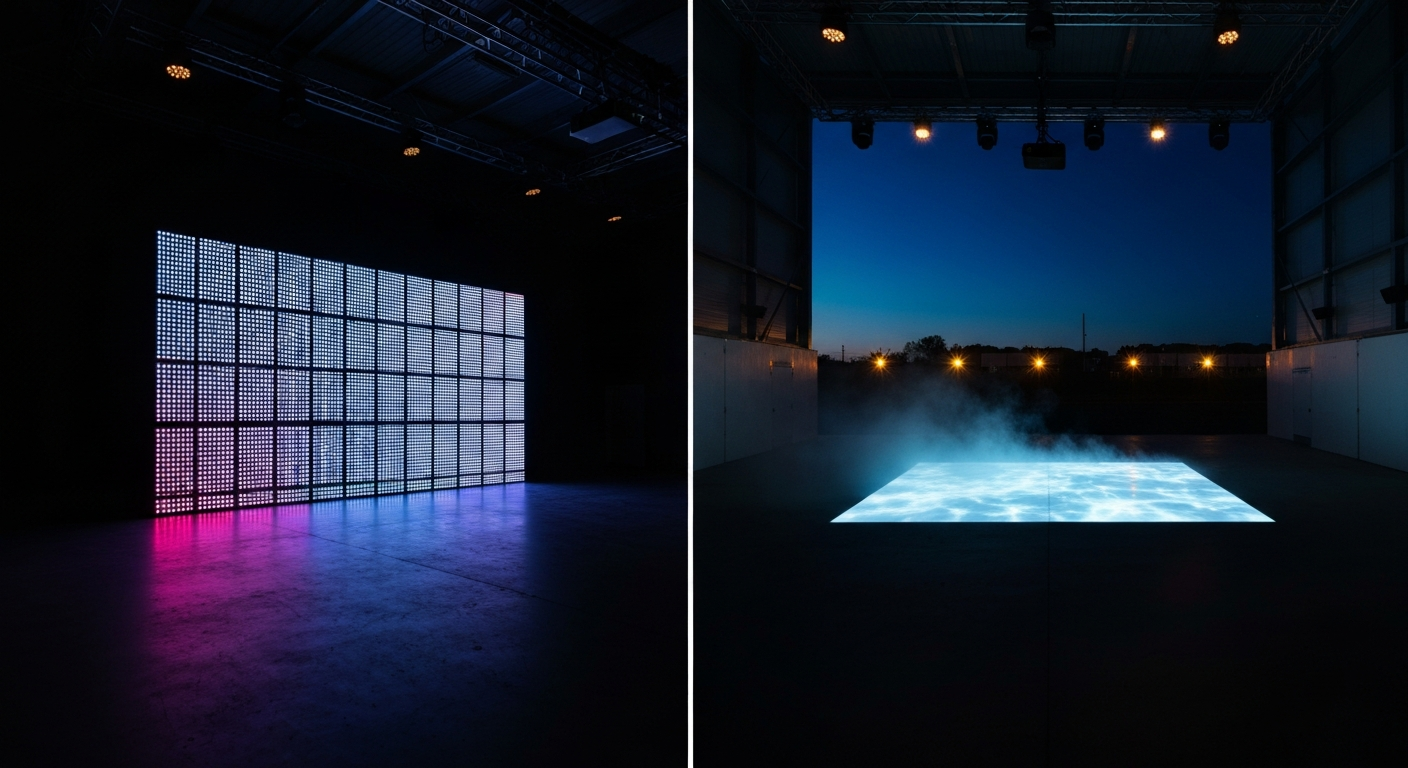
LED is a light source. Projection is reflected light. In an outdoor daytime environment, or a lobby with big windows, or a restaurant with warm overhead lighting, LED will outpunch projection every time. The inverse is true in a dark, controllable room - projection gives you black levels that LED simply cannot match because every LED pixel is an emissive source that cannot turn fully off without blacking the whole array.
If the show needs deep blacks and moody lighting, projection is better. If the show needs to cut through room light, LED is better. Start here before any other spec.
Geometry is the second question
LED panels are rectangles. Curves are possible with bendable panels or custom cabinets, but the cost climbs fast and the pixel pitch gets fiddly. Projection is surface-agnostic - a skilled mapping team can hit a column, a sculpture, a curved wall, or a matte-painted geodesic shell with no special panel fabrication.
If the surface is a flat rectangle, LED is the better answer. If the surface is anything else, projection probably wins.
Viewing distance matters more than people expect
LED pixel pitch has a minimum comfortable viewing distance. A 2.5mm-pitch wall starts to show its pixels inside about 2.5 meters. Projection, because it's reflected rather than emissive, reads as continuous until you're right up against the surface. If the audience is close - a lobby, a dining table, a small stage - projection reads as higher fidelity even if the resolution is technically lower.
If the audience is across a plaza, LED wins on brightness and durability. If the audience is within arm's reach of the surface, projection wins on how the image reads.
Power, weight, and logistics
- LED is heavy. A medium-sized LED wall needs structural engineering and serious truss.
- LED is power-hungry. Plan amperage at the front of the budget, not the back.
- Projection rigs are lighter but need projector shelves, line-of-sight, and keystone-free throw.
- Both technologies need ventilation and either can fail loudly if they overheat - LED cabinets have a distinctive failure mode where one panel goes pink.
The hybrid answer
The best shows are increasingly both. LED for the emissive hero - the center stage backdrop, the product-reveal panel, the high-brightness daytime element - and projection for everything off the hero surface: ceilings, columns, ambient wall texture, sculptural elements. Each technology is used where its physical properties are strongest.
LED vs projection isn't a tech debate. It's a physics decision. Ambient light, surface geometry, viewing distance, and audience proximity - match the tool to the physics and the show builds itself.
The studios producing the best work in 2026 don't pick a side. They pick both, and they plan the seams between them at the design stage instead of the build stage.