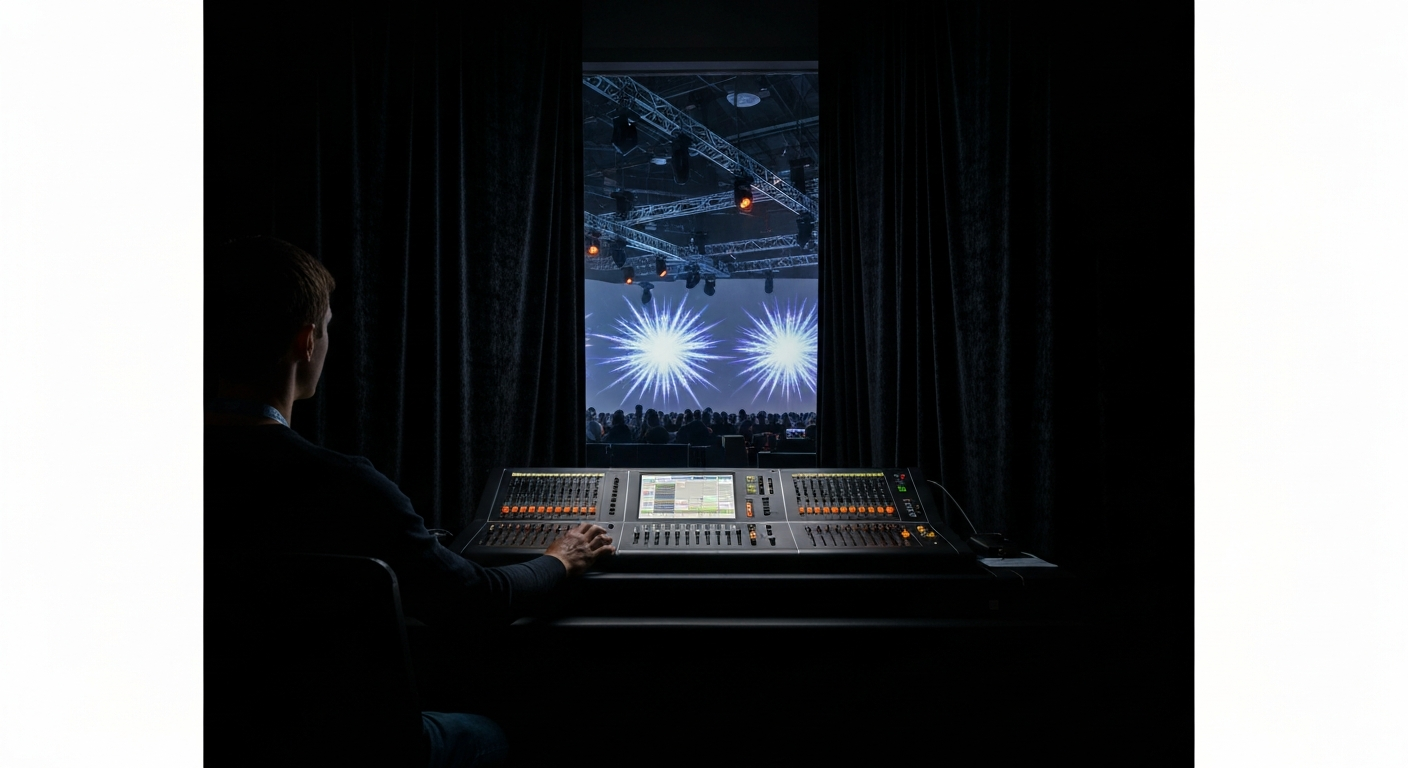
Every few years someone predicts that show-control automation is going to replace the human operator behind the console. It hasn't happened, and the people who keep predicting it underestimate what the human is actually doing. A live operator isn't "running a cue list." They're reading a room, adjusting in real time, and bridging the gap between the show as designed and the show as it's actually unfolding. No current automation does that job well, and it's worth understanding why.
Live shows deviate from the plan
A rehearsed show has a cue list and timing. A live show has whatever actually happens. The band plays a song longer. The speaker goes off-script. The crowd is quieter than expected. The venue has a power blip. An automated system has to anticipate these deviations to handle them; a human operator simply adjusts, because they can see the deviation and know how it affects the show they're running.
Automation has gotten better at this - show-control software can condition on audio BPM, on timecode, on external triggers. But these adaptations are pre-planned. An operator who sees the mainstage singer go down on one knee for an unscripted moment doesn't need to have planned a response; they fire the right cue because they understand the show.
The perceptual gap
Automation is fast and precise. Humans are slow and imprecise. For cues that need to hit a specific millisecond timestamp, automation wins. For cues that need to hit "the moment the audience is ready," humans win. Most live shows have a mix of both - some beats need sample-accurate timing, others need to breathe with the room.
A good operator recognizes which kind of cue they're firing and treats it accordingly. A cue-list automation fires everything the same way: on the scheduled frame. The difference shows up in how the show feels, not in anything the spreadsheet can measure.
Crisis mode
Every live show has at least one moment where something goes wrong. A projector fails. A performer is late. A power issue cascades. In these moments, a human operator triages: fire the safety cue, drop the failing system, adjust the running content to cover, buy time for a fix. An automated system sees the failure and either ignores it or panics; it cannot triage in the way a human can, because triage requires judgment about what the show is trying to accomplish.
This is also where institutional knowledge matters. An operator who has run this specific show 20 times knows where the failure modes live. An automation is only as good as the failure modes its designer planned for.
Where automation does win
- Pre-programmed shows with no variation - canned themed-attraction experiences, permanent installations, concert pre-shows that run the same way every night.
- Cost-sensitive productions where a single operator can cover multiple rooms via automation plus remote supervision.
- Shows with precise audio-timing needs that exceed human reaction times - fireworks synced to music, high-speed lighting cues.
- Overnight operation of long-running installations where no human is present.
These are the parts of the industry where automation has actually replaced operators. They're also the parts where nobody really minded.
The hybrid future
The interesting direction isn't "humans vs automation." It's humans with better automation tools. Show-control systems that propose cues based on rehearsal data and let the operator accept or adjust. Content that responds to operator intent rather than just operator button presses. Modern show-control work is headed toward augmented operators, not replaced ones.
Automation replaces the parts of a job that are repetitive. Live show operation isn't repetitive. It's continuous judgment under pressure, and that's still a human problem.
What this means for the production team
Don't cheap out on operators. The difference between a show that lands and a show that doesn't is often the person behind the console. Invest in operator skill the way you invest in content or hardware - it's the same category of expense, and it produces compounding returns across every show you run.