A common question from content producers new to dome work: "We have a dome show coming up - can we just run our existing reel inside the dome?" The answer is almost always no, and usually the reason is that the reel was designed for a flat 1920 by 1080 surface and the dome expects a 4K or 8K fisheye master. This post exists so the next person who asks can read it instead of getting another long email.
What fulldome actually is
A fulldome master is a square image sequence or video where the pixels are laid out in a fisheye projection - a 180-degree hemispherical view flattened to a circle inscribed in a square. The center of the frame is straight up; the edges of the circle are the horizon. A dome-control system splits the fisheye across however many projectors the dome uses, with blend zones in the overlap regions.
Target resolutions: 4K fisheye (4096 by 4096) is the common floor for touring installations. 8K (8192 by 8192) is the target when the dome is 50 feet or larger and viewers will be close to the surface. Most festival and event work lives at 4K; the 8K investment only pays off on the big installations.
Your editor is lying to you
After Effects, Blender, Cinema 4D, and Unity will all happily render you a fisheye. The problem is the preview - in a flat editor viewport, a fisheye looks warped, and designers start compensating with straightening moves that look correct in the editor and collapse to mud in the actual dome.
The fix is to preview in the dome. Every tool worth using has a way to output the fisheye to a sphere-mapped viewer. Unity has community-standard PanoDome assets. Blender's Cycles can render to a cubemap or equirect and preview in an equirect viewer. In 2D After Effects, Skybox Studio or a manual spherical projection plugin gets you close. Look at your content the way the audience will - lying on their backs in the dome - not the way your laptop shows it.
The center is where you shouldn't put anything
The center of a fisheye master is the zenith of the dome - the point straight up when a viewer is lying down. It is the hardest place in the dome to look at, and it's where people's necks start to hurt. Treat the center like you'd treat the top 15 percent of a movie screen: action and text down there forces the audience to crane.
A working rule of thumb: the emotional center of any shot sits about 40 percent out from the fisheye center toward the edge. The horizon band (the outer ring) is where faces and detail read best. Camera moves that rise from horizon to zenith read as ascending to the audience, and they work - but the payoff needs to be quick because staring up is tiring.
Tooling that production teams actually use
- Blender Cycles for rendered sequences, especially anything with procedural shaders. Equirect output then re-projected to fisheye in a comp pass.
- Notch for real-time fulldome output supported natively. The first choice when the show is live and parameters need to flex on the fly.
- TouchDesigner for generative systems, camera-reactive loops, and long-running installations that shouldn't repeat.
- After Effects for 2D motion and title cards. Render square at 4K, use the Skybox plugins for equirect preview.
- Cinema 4D when a project starts in AE and needs a 3D element. C4D plus AE is still the fast path.
Deliverables: what to hand a dome operator
Whatever the shoot looked like, the dome operator wants a fisheye master - image sequence preferred (EXR or 16-bit TIFF if the show is color-critical, PNG if not), at the target resolution, with the top-of-frame labeled so it's unambiguous which way is "up" in the rendered output. Include a zenith-safety tile so the operator can calibrate before the show. Include a frame-rate, color space, and duration sheet. Include a 5-second hard black at the front and back.
Operators receive fulldome deliveries in squished 16:9, in flat equirect with no fisheye conversion, and sometimes as a folder of JPGs named "final_v7_REAL.jpg." Every file-format fail costs the show 30 minutes of dome time nobody has.
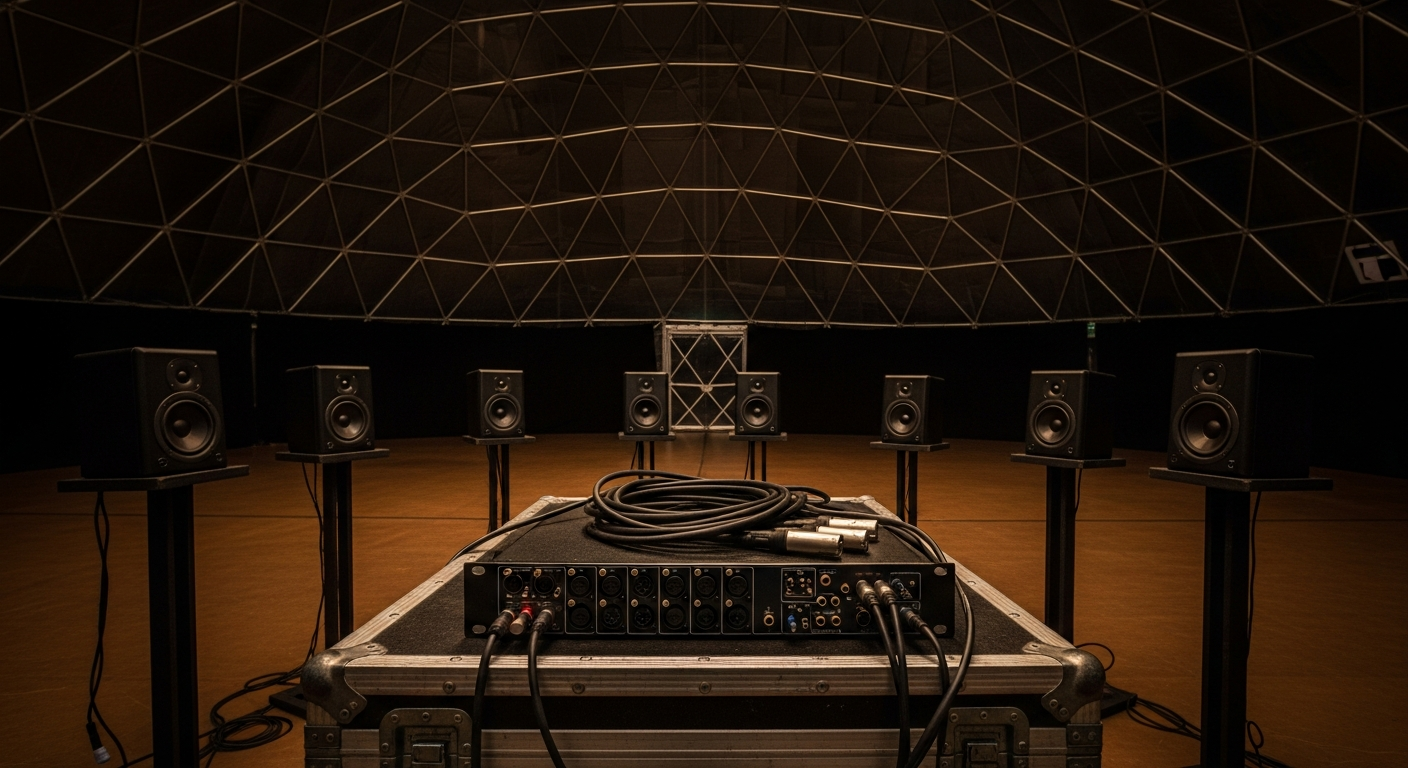
Deliver the sound field with the same care. The dome geometry that shapes your image also shapes the acoustics, and a fisheye master paired with a stereo mix throws away half the immersion - see spatial audio for immersive spaces for how the two get planned together.
If you're making content for a dome and you want a sanity check before spending three weeks rendering, the single highest-leverage move is getting eyes on a 10-second test sequence in an actual dome. That feedback loop is worth more than any tutorial.